Providing health care to the diverse people of the Toledo district in Southern Belize

Wednesday, January 23, 2013

A New Village Schedule


We started 2013 with a new schedule for visiting the remote villages and so far, so good.  We have given every village a daily schedule of where we are instead of just the dates that we will be in their village.  It appears that we have been able to reach more people, particularly in San Jose where we are going every other Tuesday instead of monthly, as some have travelled from surrounding villages when they know we are there.   We gave up going to Conejo, Midway and Crique Sarco in trade for going every Monday to Santa Ana in hopes that people from more villages would have access on that day.  Bill has been leading the team to Santa Ana weekly and it seems to be working.  The first week they saw 15 patients, the second week 18 patients and then 24 patients last Monday as the villagers know that we are there.  

Map of the Toledo District that Bill developed based on village catchment areas


We have continued to see a consistently good number in our main clinic, often close to 30 patients a day.  We only have morning clinic hours there since in the afternoons we see home-bound patients, visit schools to do education or another community outreach project. So, depending on your team of students, 30 patients can seem like a huge number.


Bill crossing a flooded river on the way to the village of San Benito Poite


I am encouraged that our women services is meeting a need in Belize.  We still struggle to convince women to have pap smears but I am getting referrals from Belizean doctors for consults and colposcopies on patients.  Recently I had a self-referral from Belize City for a colposopy.  As I spoke with her by phone, I asked how she had heard about us.  She told me that she is a nurse in Belize City and she heard that we are doing this procedure in Toledo.  She told me that there is only one person in Belize City offering these exams and patients have to pay out of pocket.  The cost of her bus ticket to Punta Gorda was much less so she was willing to make the trip down to to have it done.  We are now struggling to provide birth control to all of the women who are requesting it.  The Ministry of Health has traditionally provided us with some birth control pills and injectable contraceptives but with their budget tight, they have not had a regular supply of many medications.  If anyone has any ideas on how to obtain birth control pills or injectable contraceptives at little to no cost (our available budget), we would love to hear it.


Bill has been rooting for the Belizean football team which has made it out of the first round in the Central American Cup.  They actually tied with Guatemala (an embarrassment for Guatemala!) and beat Nicaragua.  They play Honduras on Friday evening.  There are 3 guys on the team from Punta Gorda and Will has played with them in the local football league.  Mr. Rudy doesn't have a TV so he has been over to watch the games with us.  Since they made it out of the first round, they qualify to go to the U.S. this summer to play in the Gold Cup.  Big news for Belize!!!

Morning in Aguacate


We have a doctor with us this month whose hobby is photography, Jon Rodrigues.  The photos I have included were taken by him.


Tuesday, January 1, 2013

Happy New Year!


We have a running joke amongst the Americans volunteers down here about what people in the States think we are doing in Belize vs. what we are really doing.  Belize is usually thought of as a tropical paradise with a high amount of tourism, particularly in the northern part of Belize.  This holiday season we have had a chance to experience that other side of Belize.

We really enjoyed having Bill's parents here and showing them where we live and our favorite spots.  They were able to attend our clinic's Christmas party and meet all of the Belizean staff.  A couple of days before Christmas, we rented a boat and went out to the Cayes (islands off-shore, out by the reef).  We haven't had the opportunity to do this since we have been here and it changes your perspective of where we live.  As you head out about 12 miles towards the reef, the water begins to clear and the scenery is beautiful.  The guys caught some fish on the way and when we got to Moho Caye, we had grilled fish cooked over a fire - absolutely delicious!


When it came time for them to go back to the U.S., we drove up to Belize City and had lunch on the Belize River before they flew out.  We then went into Belize City and caught a water taxi over to Ambergris Caye.  As we waited for the water taxi with a group of Americans, we realized that we were no longer Belizean volunteers but tourists for the next few days.  We did have the chance to meet a couple from California who are both physicians - a pediatrician and an anesthesiologist.  We of course told them of our work and tried to recruit short-term volunteers.

Sunrise on Ambergris Caye


Ambergris Caye was wonderful!  We definitely felt that we were on vacation.  It is a beautiful tropical island with white sand beaches and crystal turquoise waters.  We did a lot of nothing around the pool, beach and climate-controlled room.  Bill, Will and Caelan went out snorkeling a few times, including at Hol Chan and Shark Alley.  We also got our fill of American food - cheeseburgers, cinnamon rolls and pizza.  


It was interesting to see the differences in language and culture on the northern Cayes compared to the southern Toledo district.  The street language is primarily Spanish and Creole and then English where we do not have to speak Spanish frequently in the south even though we are sitting right next to Guatemala.  Their accents and English are easier for me to understand than in the south.  It might be that we are used to hearing English with a Spanish accent but not used to hearing English with a heavy Creole accent.


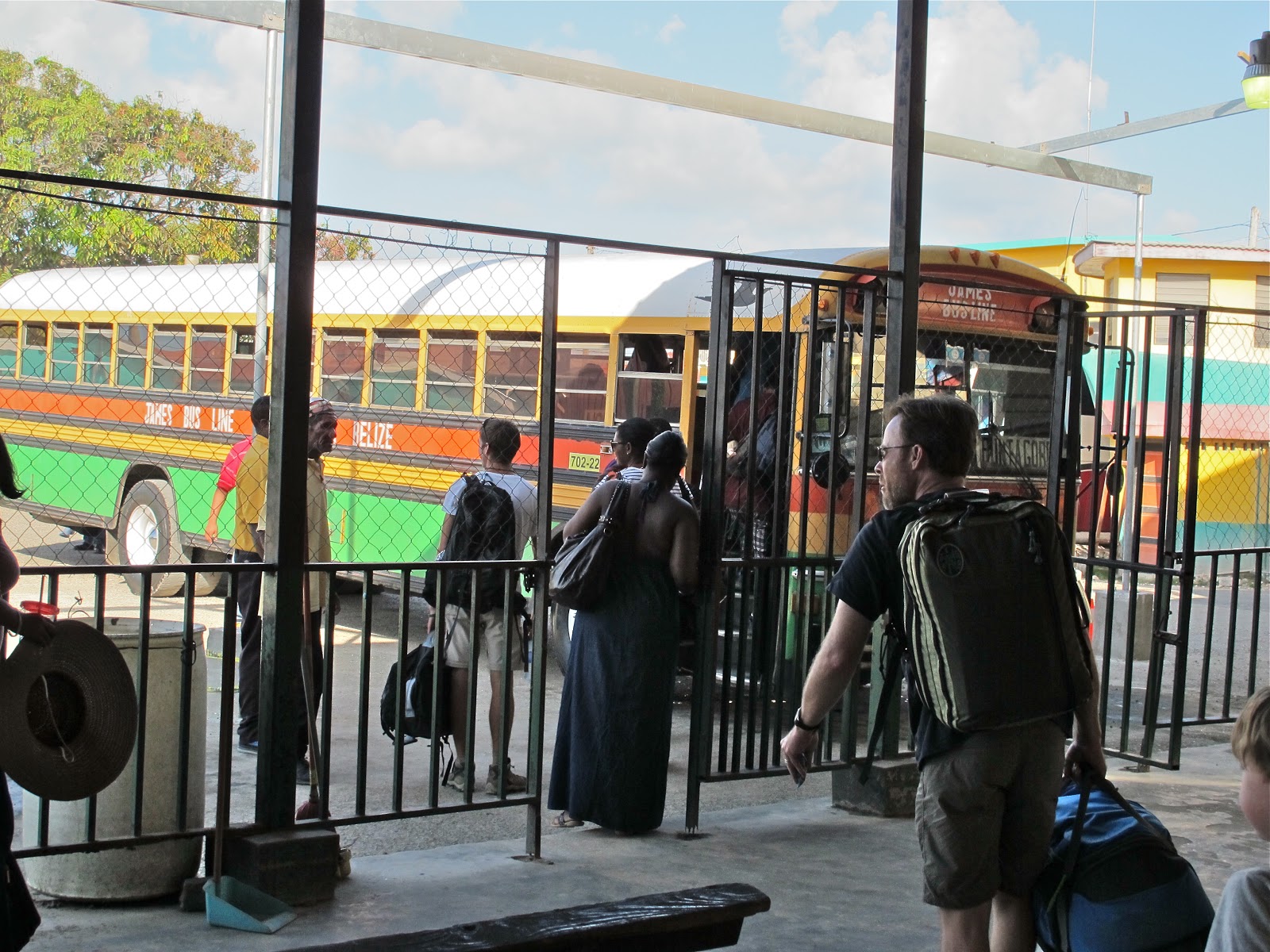
We came back by water taxi and then bus to Punta Gorda.  Once we hit the bus station in Belize City, we knew that we were back to the Belize that we were accustomed to.  We noticed right away that the buses don't go slow.  We were also serenaded with Caribbean and Spanish music for the duration of the ride through speakers that worked very well.  Crossing the Maya Mountains was like riding an old-fashioned wooden roller coaster - slowly going up the hills and then as you reach the top, plummeting down the other side at break-neck speeds, curves and single-lane bridges included.  While we have travelled up to Belize City several times in our own car, it was a markedly different experience.  The boys will have another story to tell their children.


All in all, throughout our holiday break, we have had a relaxing change of pace and definitely added to our experience of living in Belize.


Happy New Year!

Saturday, December 22, 2012

Home for the Holidays


It is hard to believe that we have been in Belize for over 6 months now.  I told my father when we last spoke that it finally seems like we are settled.  Instead of seeing the many differences of people and way of life here, I have begun to notice the similarities.  There are many more things that feel familiar.  Quinn finished his first semester in his Belizean school including exam week and received the highest marks in his grade.  He has made some friends, learned to play marbles and is enjoying playing baseball with the guys.  Caelan is comfortable spending his days at the clinic with us, doing his homeschooling on the Internet.  He is often a big help around the house.  Will has been practicing his guitar everyday - sometimes for hours at a time - and is making real music now.  Both Will and Caelan have gone along on an overnight trip to a couple of the remote villages.

Path leading to the river in the village of San Vicente


I really wanted to make our home feel a bit like Christmas and was initially at a loss as to how to do it.  There is definitely not the commercialization and Christmas trappings here and I wasn't even able to find any red cloth.  Then one of the shops in town got in a small, plastic Christmas tree and some light strands.  We were able to set it up on our dining room table and decorate it a bit.  Caelan, Quinn and I made an old-fashioned paper chain of red and white paper.  It has been so nice to have it and has added a bit of the holiday cheer to our home.  Everyone has also been looking forward to Barbara and Bill's visit (Bill's parents) for Christmas.

It does seem that as we have gotten closer to Christmas, we have been a bit homesick for the States.  Celia (our nurse) and Chad, Natalie (our pharmacist) and family left last week for the states until the New Year.  It was hard seeing everyone leave. Before they left, we were visiting and they were talking about what they were looking forward to: different types of foods, carpeting, no bugs or bug bites, clean environments and not feeling dirty all of the time.... I think we were definitely wishing we were going up for a visit as well.  But then I realized, there are lots of things we miss but we don't NEED anything.


On a funny note, "superstitions" are abounding in our house.  The only hot water in our house is by an electrical shower head that heats the water as it goes through it.  For some reason, recently we have been without power a lot in the mornings which means cold showers. There have been several instances that the electricity has come on just after Bill has finished his cold shower.  Quinn has thought it hilarious that Bill has had to take cold showers and has gone into the bathroom with a battery-powered fan aimed at him in the shower as a joke. This past Sunday the power was again out.  After a couple of hours, Quinn started begging Bill to take a cold shower so that the electricity would come back on.  After awhile we suggested to Quinn that he be the one to take the cold shower and see if it made a difference. Quinn finally thought it might be worth it and after hearing sqeaks and squeals from the cold shower, Quinn emerged.  As he stood there dripping wet and laughing, the power came on.  Then Quinn was convinced, "Somebody has to sacrifice themselves for the family."   Caelan's dry, intellectual approach was that it was "not only a coincidence but an unfortunate event."


We wish you all, our family and friends, a wonderful Christmas and a Happy New Year!


                                          For to us a child is born,
to us a child is given,
And he will be called
Wonderful Counselor,
Mighty God,
Everlasting Father,
Prince of Peace


Wednesday, December 12, 2012

A Women's World


Most people are aware that my interest is in Women's Health but it has been more challenging to me here than anywhere I have ever been before.  The Maya women have me stumped!  As a physician I am trained to observe.  I will admit that I am not usually that observant of peoples' physical traits but when I walk into an exam room, it is data collection time.  What does the patient look like?  How are they dressed?  How old are they?  How do they interact and respond to me and to my recommendations?  


For starters, there are very little facial expressions.  I can usually judge if someone understands what I am saying by their face but here most faces are blank even when they are engaging in conversation with you.  I have watched them talk amongst themselves with more animation but with the "white doctor," it is a blank face.

Next, it is difficult to examine them.  They are very open about breastfeeding and will do it publicly without any covering until the child is about 2 years old, on the street, in church, etc., but the moment you want to examine their abdomen, they are pulling their clothes over themselves and hesitant.  It is very difficult to convince them to have a Pap smear or a pelvic exam even if they are symptomatic.  Many times they will simply refuse.

That said, I have great empathy for the Maya women.  From my industrialized country perspective, they live a very difficult life.  They marry young and have many children.  For some reason, it is very common for them to have 10 children.  Although we bring options for family planning with us, there is still some stigma associated with it.  We often see patients in open areas with very little privacy from the other villagers which makes it more difficult for the women to discuss these things.  The women often really want these services but are afraid of what the other villagers (or her husband) might think.


Women wait with their children to be seen in the village of San Jose
A Maya "washing machine" - stones set in the river for washing


Their daily work is not easy.  They have to carry their laundry to the river where they wash their clothes on rocks while their children play in the water.  They then carry these buckets of wet clothes home and hang them to dry.  They have to haul drinking water for their family from the village wells.  Most villages now have a communal corn mill powered by a generator but they still must take the corn to the mill before every meal to grind it and then make tortillas over an open fire in the hut.  They sew their family's clothes on a pedal sewing achine or weave cloth by hand on a loom.  Most of this is done while carrying their babies and even toddlers in slings from their heads.  Many go from looking very young when they are first married to looking 20 years older than their age within a decade.  They suffer from chronic headaches and backaches from the heavy work.  Many develop COPD (chronic obstructive pulmonary disease otherwise known as emphysema) and have carbon monoxide headaches from cooking over open fires without ventilation in their thatch-roofed huts.  There are a couple of organizations that have worked to provide well-ventilated cooking stoves for the Maya people in Guatemala however, the Maya of Belize have not been accepting of these.  They also develop significant degenerative joint disease, especially in their knees and shoulders.

So we give them a lot of Tylenol or Ibuprofen.  We treat their lung disease symptoms with inhalers and we inject many joints with steroids for comfort.  We have only seen a handful of cases of depression in these women even though we have asked and looked for it.  We just have to continue to educate them, encourage them to have regular pap smears and pelvic exams and otherwise to try and be there to care for them.


Wednesday, November 28, 2012

Duffle Bag Medicine


"Duffle Bag Medicine" is a term that became popular after an article was published in JAMA (Journal of American Medical Association) in 2006 with this title.  The article describes a typical medical mission trip to rural Guatemala and describes what often happens when good-intentioned people go to third world countries in an effort to provide medical care.  We have seen this here in Belize as well.  A group comes down from the U.S. with bags full of vitamins, medicines and medical supplies.  They set up clinics in rural villages to see as many people as possible for a week and then leave to go back home.  On first look, this is seen as a great thing and those providers who come down and sweat it out in the jungle seeing lots of patients often feel really good about what they are doing but there can be huge problems associated with this approach.  First, these groups have no continuity of care and often operate without any knowledge of the patient's medical history.  The short-term work is not integrated into the local health infrastructure and so after the group is gone and the 30 days of dispensed medications have been taken, the patients are right back where they started.  These medications are sometimes not even available in the area and so even if sought, the treatment is not sustainable.  Second, public health and preventive health measures are usually not a part of the goals of the transient clinics.  All together, the result of these mission clinics do nothing to improve the overall health of a people and can even be harmful.


Here in the Toledo district of Belize, we at Hillside have attempted not to approach the delivery of healthcare in this way but to complement the present Belizean healthcare system and provide true primary care.  This past week Bill and I were able to sit down for a few hours with one of the Belizean doctors from a local government clinic, Dra. Peitra Arana, and her clinic administrator as well as Joyce, our clinic administrator.  Dra. Arana started about the same time we did in the Toledo district after finishing her training in Guatemala and although she initially seemed very reserved with me, we have been slowly building a relationship.  The big breakthrough came when she had a family of 9 from an outlying village who were infested with worms.  She had tried the traditional medication that the government clinics provide, abendazole, with no success.  She mentioned these cases to me one day at the government clinic when we did our regular morning stop to pick up charts for one of the villages.  We had recently acquired a large bottle of Ivermectin which I was able to share with her for this family.  Although she has few resources, she is passionate about her patients and was willing to try and speak out about the issues confronting us at the medical conference in Belize City.  

Barranco - our only Garifuna village

We sat down with them to make a strategy for this next year.  The geographical distances and lack of transportation in the Toledo district is huge.  The government physicians have no way to get out into the villages consistently to provide care and so have staffed more centrally located clinics while we have provided the mobile clinics into the villages in addition to our own centrally located clinic in Punta Gorda.  Even with these arrangements, we are able to only cover a bit over half of the villages and then only once every 3-4 weeks per village. There are a handful of villages which do not have roads into them and we rely on them to walk 1-2 hours out of the jungle to one of the other villages where we are holding clinic.  The question is, is that adequate?  Shy of recruiting many more volunteer physicians who could live in each village, is there another way to approach the needs?  Can we really call it primary care medicine instead of "duffle bag medicine" if we are only in a village once a month?  Yet we do keep medical records on all of our patients and have continuity from month to month with each of our villages.     


There are definitely no easy answers.  No decisions have been made as of yet but will need to be soon.  With 70% of our monthly in-country budget going to vehicles and gas to get us out to the people, it is something that needs to be contemplated.  There are not as many chronic patients out in the farthest villages but that is most likely because they have not been diagnosed.   I feel that we are doing the best with our current restraints and lack of resources while Bill has been brainstorming about staffing outlying clinics more consistently that are placed central to several of the farthest villages.  Transportation remains one of the biggest hurdles to care.  Would we be able to provide transportation to our patients with chronic illnesses like diabetes and hypertension to leave the village for their care?  If we were consistently in a particular place, would we make those diagnosis of chronic illnesses better and be able to treat?


Saturday, November 17, 2012

The Forgotten District


This past week Bill and I went up to Belize City to attend the Belize Medical and Dental Association International Congress.  It was two days of medical education lectures for physicians practicing in Belize as well as Guatemala and the Quintana Roo area of Mexico.  It was nice to see the advances being made in medical care in Belize and there were some very well presented lectures in English as well as in Spanish.  The care in Belize City is still decades behind that of the U.S. in many ways but there are some good, very intelligent physicians working hard to make a difference.

We had the opportunity to meet an American doctor and her husband who are running another mission clinic in the northern part of Belize.  Although the north is far more developed, has a very different culture being so close to Mexico and has much more access to care, it was great to spend some time together.  Even though they are from Indiana, there was great camaraderie and a good exchange of ideas.  Their clinic is better outfitted than ours and they gave us some stateside contacts that might be helpful for us.  We live a bit more rustic and quite a bit more isolated than they do but she is jealous of my clothes dryer!  (Something I requested of Hillside before we came.). They have 3 girls - the oldest is Caelan's age and the youngest is Quinn's age and the boys enjoyed visiting with them over dinner.  

What was striking from the conference was the number of foreign physicians practicing in Belize - particularly Cuban and Guatemalan.  Belize does not have a medical school and has traditionally relied on the goodwill of Cuba to provide primary care physicians and more recently to train Belizean physicians.  It creates huge barriers in communication as the official language in Belize is English and the street language is Creole and unfortunately the Cuban physicians speak very little English.


The other striking thing was, like we experienced in rural U.S., the distribution of healthcare is not equitable.  The southern Toledo district covers an area of 1795 square miles and a population of over 30,500 but with only a handful of primary care physicians (including Bill and I).  Many of these people have very little or no access to the healthcare centered around Belize City.  Unfortunately, the people responsible for the healthcare decisions in the Ministry of Health do not seem to understand the access problems faced by those in the Toledo district.  For one of our patients in the village of Dolores to access care, they have to walk about 1 hour to the village of Otoxha where they can catch the Monday, Wednesday, Friday or Saturday bus at 4:30 am for a 2+ hour bus ride to Punta Gorda.  They have no access out of the village to care on Tuesday, Thursday or Sundays.  As I have mentioned before, if they need an x-ray, they have to take another bus about 2 1/2 - 3 hours north to Dangriga.  All the specialty care is centered around Belize City and Belmopan, 6 - 8 hours by bus north of Punta Gorda.  We have given many people bus fares for the trip north but they still have to come up with a place to stay as well as food to eat.  We have known these things for quite a while but our time at the conference in Belize City solidified our concerns - the Toledo district is really "the Forgotten District."


Saturday, November 10, 2012

Thanksgiving in Belize


The Thanksgiving Day holiday celebrated with pilgrims, turkey, stuffing and cranberry sauce is a unique holiday to the U.S. however, people all over the world celebrate the harvest season.  At the beginning of November, the Harvest Thanksgiving is celebrated here in Belize.  The children practiced in school for their parts in the program and places are decorated with stalks of sugar cane, citrus fruits and dried ears of corn.

The corn has been harvested here in the villages and this a major staple in their diets.  When you are in the villages you can hear the corn mills before every meal as they grind the corn for masa to make their tortillas.  The citrus is also coming ripe - the market is now full of grapefruits, oranges and limes.  The Stann Creek District north of the Toledo district is home to many citrus orchards and there are trees scattered around our area as well.  

Quinn, his teacher and some other people in the community helped educate us on our part in the Harvest celebration.  Traditionally people bring a small part of their crops as a gift to the church in brightly decorated containers.  The church then distributes it to the poor or sells it to bring in some money.  Living in town with no fruit bearing trees, we did not have any "crops" to bring so our basket was filled with homemade banana muffins and cookies.  We decorated our basket with flowers from around our house to make what I call our Belizean cornucopia.

Belizean Cornucopia


The boys of Quinn's class presenting their gifts and telling what they are thankful for

 Girls in Quinn's class doing a Liturgical dance to Give Thanks With a Grateful Heart


Give thanks with a grateful heart
Give thanks to the Holy One
Give thanks because he has given 
Jesus Christ his son

And now let the weak say I am strong
Let the poor say I am rich
Because of what the Lord has done for us
Give thanks

- written by Henry Smith